
Tracing Former Owners of a Westchester County Property
Every Westchester deed names its grantor, grantee, and prior instrument.
| Source | Years It Covers | Where Held | What It Shows |
|---|---|---|---|
| Westchester Records Online | Current online index | County Clerk and WRO | Indexed grantors, grantees and recording dates |
| County Clerk deed books | Historic coverage varies | County Clerk records room | Earlier recorded parties |
| County Archives map collection | Historic coverage varies | County Archives | Filed-map and subdivision clues |
| Dated municipal assessment rolls | Historic coverage varies | County Archives and local history collections | Dated owner entries |
Follow the deed records transfer by transfer, back through time.
Walking the Westchester County Deed Chain Backward
A backward walk through the deed chain starts with the owner of record.
- Trace each Westchester deed backward by grantor, grantee, recording date, legal description, and prior-instrument reference, documenting every gap.
- Trace each Westchester deed backward by grantor, grantee, recording date, legal description, and prior-instrument reference, documenting every gap.
- Trace each Westchester deed backward by grantor, grantee, recording date, legal description, and prior-instrument reference, documenting every gap.
- Trace each Westchester deed backward by grantor, grantee, recording date, legal description, and prior-instrument reference, documenting every gap.
- Grantor / grantee
- Trace each Westchester deed backward by grantor, grantee, recording date, legal description, and prior-instrument reference, documenting every gap.
- Chain of title
- Trace each Westchester deed backward by grantor, grantee, recording date, legal description, and prior-instrument reference, documenting every gap.
- Legal description
- Trace each Westchester deed backward by grantor, grantee, recording date, legal description, and prior-instrument reference, documenting every gap.
How Far Back Westchester County Ownership Records Go
Trace each Westchester deed backward by grantor, grantee, recording date, legal description, and prior-instrument reference. A deed chain stays reliable when every gap between recorded transfers is documented and flagged.
Lawful use. Trace each Westchester deed backward by grantor, grantee, recording date, legal description, and prior-instrument reference, documenting every gap.
Build a reverse Westchester deed timeline
Begin with the newest confirmed deed in Westchester Records Online. Copy its grantee, grantor, recording date, instrument reference, municipality, and legal description. Then search that grantor as an earlier grantee. Open that deed and repeat. Every link must describe the same parcel. A shared surname is never enough to connect two instruments. Trust transfers, estates, entity deeds, corrected instruments, and lot splits or mergers all create branches. Only careful reading of the document can resolve them.
WRO registration is separate from paid images. The platform charges $20 daily and $1,200 annually for image licensing. Certified copies come only from the County Clerk. The copy disclaimer makes clear that online convenience is not certification.
Bridge older descriptions with Westchester maps
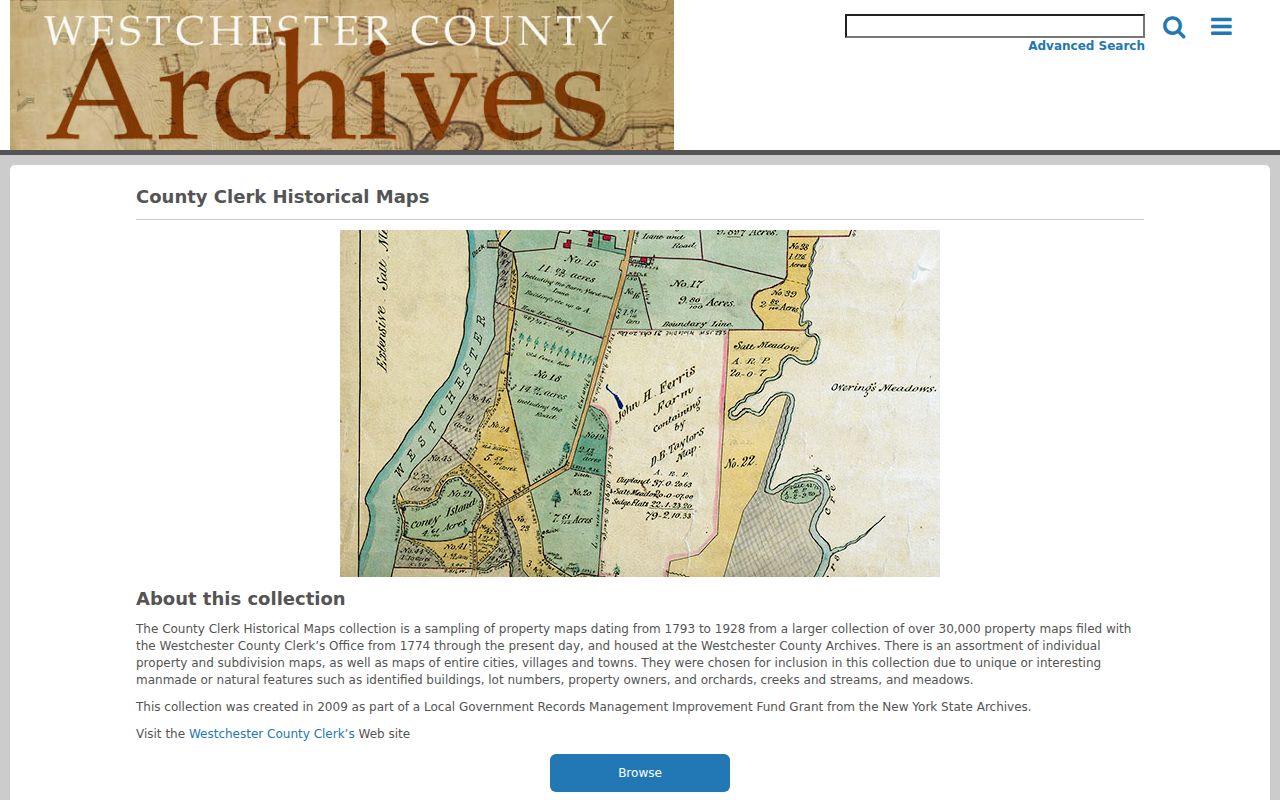
Chains often hit descriptions that no longer match modern geography. When a Westchester deed cites a subdivision, ward, estate, or railroad feature, follow its filed-map reference into the County Archives map collection. Old plats translate the language. Yonkers deeds may speak of Getty Square, Saw Mill, Nepperhan, and old industrial or ward names. New Rochelle waterfront parcels can surface in project tax-lot lists. Mount Vernon tax maps track subdivisions, mergers, and address changes over time.
Use dated rolls as checkpoints, not chain substitutes
Assessment rolls are checkpoints, not substitutes. A dated roll shows who was listed as owner in a given year. That helps test a deed timeline. It cannot replace the recorded instrument itself. Preserve the roll year and the exact field label you relied on. New Rochelle's 2024 roll carries deed book and page data plus May 1 values. Yonkers separates its 2026 tentative from its 2025 final materials. Mount Vernon's annual roll and semiannual map work run on their own dates.
Finish with a table. List each recorded transfer, instrument, recording date, parties, legal-description match, and any unresolved gap. State the oldest source actually inspected. A complete title conclusion belongs to a title professional. Public research can reconstruct the evidence without promising that every affecting instrument surfaced.
Handle Gaps in a Westchester Ownership Chain
A missing link usually signals an indexing or geography change. It is not a stretch of ownerless land. Search the party under spelling variants, initials, and trust or estate forms. Widen the date range. Follow the prior-instrument recital printed inside the deed itself. Compare the legal description against filed maps. Also try the earlier SBL, subdivision, lot, ward, estate, or railroad feature. Dated assessment rolls can anchor a checkpoint between two recorded transfers. But a roll entry should never stand in for the missing deed.
When WRO coverage or image access stops short of the period you need, visit the County Clerk records room. Request the deed book or a certified copy. County Archives maps can translate older descriptions. Municipal assessors may hold historic tax-map sheets or property cards. Record the channel used and the access date. Note the oldest deed actually inspected. Write down every interval left unresolved. That discipline keeps the work useful even when it falls short of a full title abstract.
Distinguish Ownership Events From Other Recorded Events
Not every recorded document transfers ownership. Mortgages, assignments, satisfactions, easements, covenants, leases, and boundary agreements all name parties. The fee stays untouched. Place them beside the chain only for the interest they document. A nominal transfer into a trust, between related entities, or through an estate may show a consideration figure. That figure is no open-market sale price. Treat those numbers with care.
Build the final timeline with separate columns. Use them for instrument type, grantor, grantee, recording date, parcel match, prior reference, and notes. This structure preserves uncertainty. It also keeps a mortgage borrower, executor, trustee, or easement holder from being mislabeled. None of them is a former fee owner of the Westchester parcel.
Preserve the exact indexed name for each former owner. Do not modernize spelling or merge people who share a surname. Note the source of every fact. It may be a deed, an assessment roll, a directory, a map, an estate instrument, or a secondary history. A dated directory can establish an address association, but not fee ownership. A tax roll can establish the assessed owner for its year. It never replaces the recorded conveyance. These distinctions keep a long Westchester property history accurate.
When publishing the result, skip personal biographies that add nothing to the parcel chain. The point is to document transfers, map changes, and the property's recorded history. Profiling former occupants is a different project entirely.