
The Values on a Westchester County Property Record
Five distinct figures travel under the word value, and each has its own source, date, and purpose.
| Value | What It Is | Where |
|---|---|---|
| Assessed value | Keep assessed value, full-market estimate, recorded sale consideration, asking price, and private appraisal separate and dated. | municipal assessor |
| Market / appraised value | Keep assessed value, full-market estimate, recorded sale consideration, asking price, and private appraisal separate and dated. | municipal assessor |
| Last sale price | Keep assessed value, full-market estimate, recorded sale consideration, asking price, and private appraisal separate and dated. | Keep assessed value, full-market estimate, recorded sale consideration, asking price, and private appraisal separate and dated. |
| Land vs improvement | Keep assessed value, full-market estimate, recorded sale consideration, asking price, and private appraisal separate and dated. | municipal assessor |
A Westchester County property record can carry assessed value, a full-market estimate, deed consideration, an asking price, and a private appraisal side by side.
Looking Up a Westchester County Property Value
Start with the parcel number, then pull the roll entry and deed separately for each Westchester County property.
- Keep assessed value, full-market estimate, recorded sale consideration, asking price, and private appraisal separate and dated.
- Keep assessed value, full-market estimate, recorded sale consideration, asking price, and private appraisal separate and dated.
- Keep assessed value, full-market estimate, recorded sale consideration, asking price, and private appraisal separate and dated.
- Keep assessed value, full-market estimate, recorded sale consideration, asking price, and private appraisal separate and dated.
- Assessed value
- Keep assessed value, full-market estimate, recorded sale consideration, asking price, and private appraisal separate and dated.
- Market / appraised value
- Keep assessed value, full-market estimate, recorded sale consideration, asking price, and private appraisal separate and dated.
- Level of assessment
- Keep assessed value, full-market estimate, recorded sale consideration, asking price, and private appraisal separate and dated.
What a Westchester County Assessor Value Is Not
The assessor's full-market figure is an administrative estimate for taxation, not a promise of what a Westchester County parcel will sell for.
Value vs price. Keep assessed value, full-market estimate, recorded sale consideration, asking price, and private appraisal separate and dated.
Separate assessment, full-market estimate and sale consideration
An assessment is the number the municipal tax roll actually uses. The full-market field beside it is an administrative estimate tied to that same roll. Sale consideration is different. It comes from a recorded deed or transfer source. An asking price belongs to marketing, not to any recorder or assessor document. A private appraisal serves yet another purpose and carries its own effective date.
Build a small table before comparing anything. Give each figure its label, its source, its date, and its purpose. New Rochelle's 2024 roll shows the habit clearly. Its verified 115 Kensington Oval entry reports a Total Assessment of $41,760. Its Full Market Value is $2,163,731. Those two numbers are not interchangeable. Neither one is the deed's sale consideration. Treating the larger figure as the price paid is the most common reading error. That error shows up all over Westchester County property records.
Read the Yonkers card without overreading property class
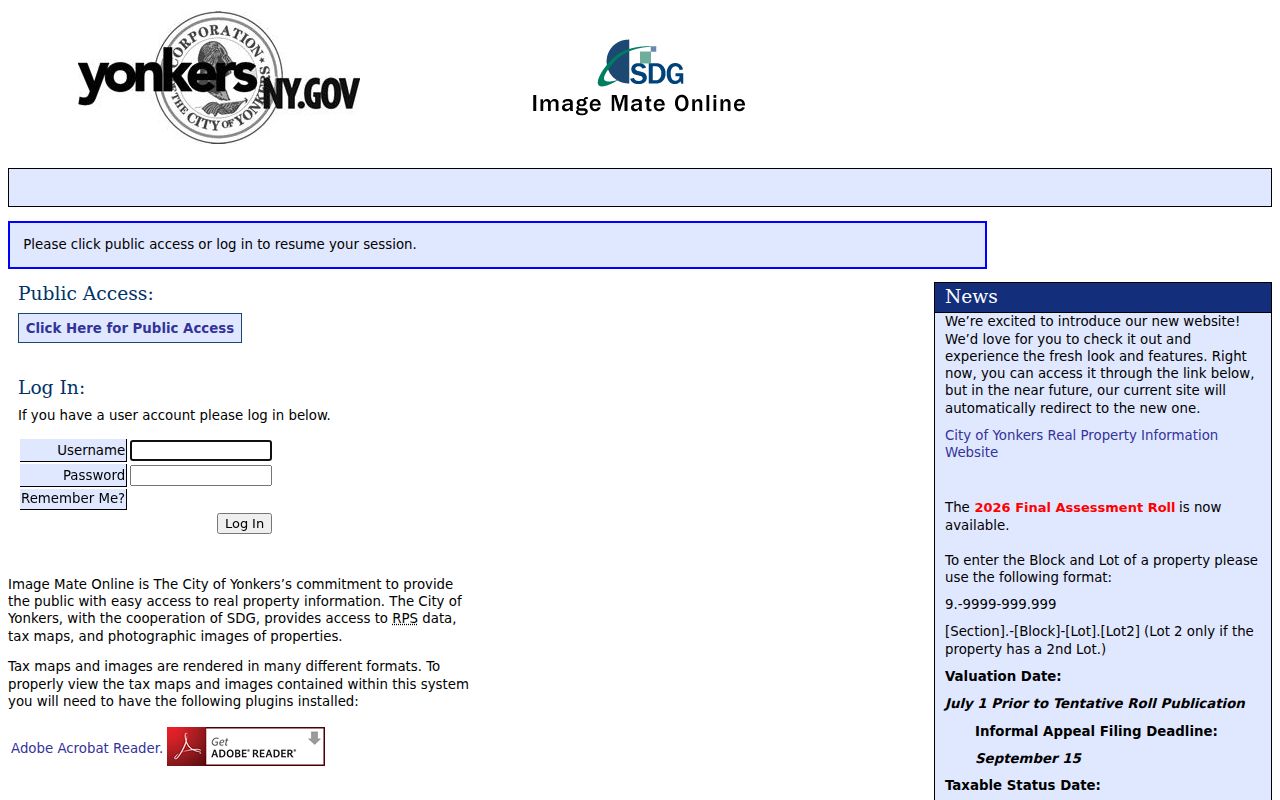
Yonkers Image Mate's verified 115 Ridge Drive card puts assessment, full-market, deed, and map references on one screen. It is tagged class 311 residential vacant land. The class alone tells you very little. It does not mean the parcel is abandoned, buildable, accessible, or free of permits. Read it alongside current zoning, building records, and the parcel itself.
The sample card shows how the fields are arranged.
Compare like dates and like parcels
Check that any comparison uses the same municipality, property type, lot configuration, and relevant date. A split, merger, renovation, or exemption can quietly make similar-looking figures meaningless. The timing varies across Westchester County. Mount Vernon updates its tax map semiannually and its roll annually. New Rochelle uses May 1 valuation data in the cited 2024 roll. Yonkers publishes tentative and final rolls for different years.
For a grievance, timing is everything. Keep the applicable roll, the land and total assessment, your claimed market value, and your evidence inside the local deadline. For a purchase, lean on recent verified sales and appropriate professional advice. A tax bill measures charges after rates and exemptions. It is not a standalone statement of market value.
Explain Why Westchester Value Figures Diverge
Each system answers its own question. Assessment exists for taxation. Deed records document transfers. An appraisal estimates value for a defined purpose and effective date. The roll's full-market figure may be derived through an equalization process. So it is not necessarily what a buyer paid. Deed consideration can reflect a non-arm's-length transfer, multiple parcels, personal property, or another condition. That makes it a weak comparable on its own. A tax bill then adds rates, exemptions, and district charges after the assessment stage.
Before comparing Westchester County parcels, match municipality, roll year, class, lot size, building type, condition, and date. Confirm whether a parcel was split or merged. Confirm whether improvements were complete by taxable status. Never read a vacant-land class as a statement that a parcel is abandoned or buildable. Check zoning, permits, access, utilities, and flood or coastal constraints. Those sit in the separate records that govern them.
Prepare a Value Record for Review or Grievance
Save the full roll entry, not just the headline number. Record the owner label, SBL, property class, land assessment, total assessment, full-market field, taxable values, exemptions, school and special districts, and roll status. Record the source date too. Add the newest deed and verified sale evidence. Do not relabel its consideration as an assessor value.
For an assessment complaint, follow the municipality's own calendar. Preserve the market-value opinion you submitted, the comparable evidence, and representative information. Keep any appointment or hearing date and the decision. New Rochelle's February grievance timing and Mount Vernon's June-to-August roll sequence show this clearly. No single countywide deadline would be honest. A successful or pending complaint changes none of the title, zoning, permits, or surveyed boundary.
The question may be a purchase price, an estate valuation, a lending appraisal, or a litigation position. Bring in an appropriately qualified professional. The public records still earn their keep. They identify the parcel, the dates, and the administrative figures. They also identify the recorded sales that the professional can then evaluate.
A clean comparison sheet names the source of every number. It keeps the math visible on its own lines. Record municipality, SBL, property class, roll year, and valuation date. Add assessment, full-market estimate, exemptions, and taxable values. Note the deed date, the consideration, and whether the transfer appears arm's length. Pull parcel-size and building facts only from the dated inventory. Flag renovations or map changes that make earlier figures less comparable.
Recheck the official roll before filing an appeal. Do the same before relying on a value in a transaction. Corrected rolls, exemptions, or later municipal decisions can change a figure you downloaded earlier.